

The safest place for a pet on a hot moving day is somewhere else. Put two sources side by side and you find a step most moving checklists miss. RSPCA Australia notes that many people leave pets with a trusted friend or in boarding on moving day. The NSW Pet Registry says that if a pet lives at another location, "even temporarily", you must update its location. For a cat or dog, then, the calm option is also a registry update, and the new house is a second one.
That is the paperwork. The day itself turns on three risks: heat, open doors and stress. RSPCA NSW warns that heat stress can develop extremely quickly. A parked car is never a waiting room. And a pet let loose in a house full of strangers and boxes has more ways out than you'd think.
Here is the plan Vaucluse Removals would give a friend moving with a pet this summer, from the dawn walk to the first week in the new place. If you're still choosing a date, our guide to moving house in a Sydney summer covers timing and booking. This one is about the animals.
Where should the pet be on moving day?
A removal day opens a house up. The front door gets wedged and the side gate propped, and people walk in and out carrying furniture for hours.
The risk starts before the truck arrives. In the weeks before a move, RSPCA Australia says, prospective buyers or tenants may leave doors or gates open, and packing can put unsafe items within a pet's reach. Loose batteries waiting for a drop-off are worth putting up high. Our Woollahra clear-out guide says where they go. The same RSPCA advice notes that pets pick up on your stress.
So on the day, your pet has four sensible places to be:
- a boarding facility
- a home-visiting sitter
- a trusted friend or family member
- one closed room at home, with someone checking in.
The car is not on that list.
If the pet stays at home, RSPCA Australia is plain about it: don't leave it unattended, keep it in one room with food and water (or in its crate if crate trained), and use a suitable carrier for cats and small dogs. Pick the coolest room, away from the western sun and the front door. Then tape a sign on the door so nobody opens it looking for the last box.
Boarding, a sitter or a friend: what to check first
| Option | What to check |
|---|---|
| Boarding facility |
|
| Home-visiting pet sitter |
|
| Trusted friend or family |
|
| One closed room at home |
|
Boarding takes some lead time. To stay at most facilities, a pet needs up-to-date vaccinations, worming and external parasite control. RSPCA Australia suggests you visit the facility first, ask about temperature control and airflow, and consider a trial stay. In December, that airflow question matters more than anything else on the tour.
Some animals cope badly away from home. For them, a home-visiting pet sitter may suit a pet that gets stressed by boarding. Whichever you choose, make sure the pet's ID details are up to date before it goes.
A friend's place is often the easiest answer. For a cat or dog, remember the registry step from the top of this page: a stay elsewhere, even a short one, is a location to record.
Why a hot Sydney moving day is harder on pets
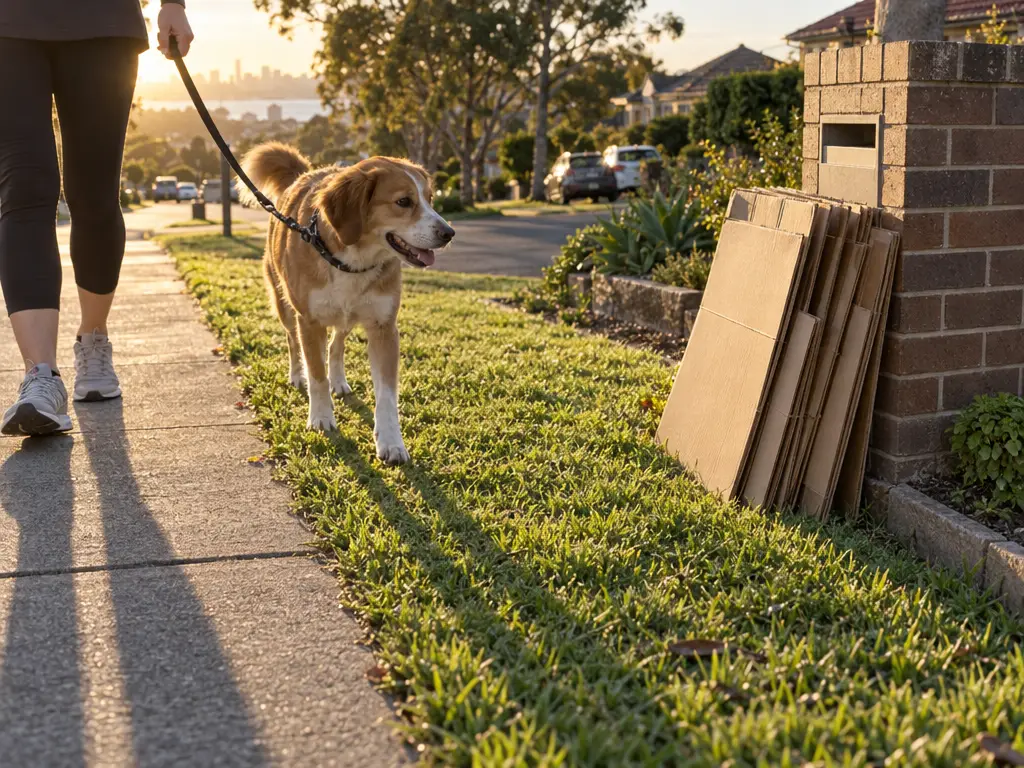
Sydney's mean maximum across its whole record (1859 to 2020) was 25.3°C in December and 26.0°C in January. That is a long-run average, so the hot days run well above it. A moving day is not an average day either. Doors stand open, the driveway bakes and everyone is too busy to notice a panting dog.
RSPCA NSW says that in summer animals need constant access to water and shade. It also stresses that all companion animals are vulnerable to heatstroke, including cats, rabbits, guinea pigs, birds and fish.
| Group | Examples or note |
|---|---|
| Flat-faced dogs | Pugs, Bulldogs, Boxers and Boston Terriers |
| Flat-faced cats | Persians |
| Overweight pets | |
| Very young or senior pets | |
| Pets with heart or breathing problems | |
| Small "pocket pets" in cages or hutches | Cages and hutches "can become heat traps" |
| All companion animals are vulnerable to heatstroke, including cats, rabbits, guinea pigs, birds and fish. | |
Some animals need more care than others. RSPCA NSW lists flat-faced breeds, overweight pets, very young or senior pets, pets with heart or breathing problems, and small pets in cages or hutches as higher risk. It warns that a hutch or cage "can become heat traps". A rabbit's hutch belongs in the shade until the last minute. It should travel with you in the car, never stacked among the furniture.
Do the dog walk before the crew arrives. RSPCA NSW advises walking dogs in the early morning or late evening, because asphalt and concrete can burn paw pads. Inside, offer extra water bowls in case one is knocked over. On a day of busy feet in the hallway, assume one will be.
Driving to the new place: where the pet rides, and why it never waits in the car
A dog left in a car "could die in as little as six minutes."
RSPCA NSW
NSW road rules are specific about animals in vehicles. You must not drive with an animal in your lap, or while an animal is being led from the vehicle or tied to the outside of it. Animals "should travel in an appropriate area of your vehicle". A carrier or crate, settled where it can't slide, does that job.
The harder rule is about stopping. RSPCA NSW says a dog left in a car "could die in as little as six minutes". Six minutes is shorter than a coffee queue, and shorter than a quick dash back to the old house for the keys.
Cracking a window or parking in the shade does not make a parked car safe: RSPCA NSW says open windows, shade parking and tinting "do not help to reduce the inside temperature significantly".
Plan the drive so the pet is never alone in the car. Either someone stays with it, or it goes straight from one door to the other.
Heatstroke signs and what to do while you call the vet
Know the signs before the day, not during it. RSPCA NSW lists frantic panting or rapid breathing, heavy drooling, weakness or confusion, bright red or pale gums, vomiting or diarrhoea, and shaking, seizures or collapse.
If you suspect heatstroke, RSPCA NSW gives three first aid steps:
- Move the pet to a cool, shaded area.
- Apply cool (not ice-cold) water to the fur, focusing on the belly, groin and paw pads.
- Increase airflow, offer small sips of water without forcing, and contact a vet immediately.
First aid is what you do while you ring the vet, not instead of ringing. Save your vet's number in your phone the week before. Look up a clinic near the new address too.
The first days in the new home
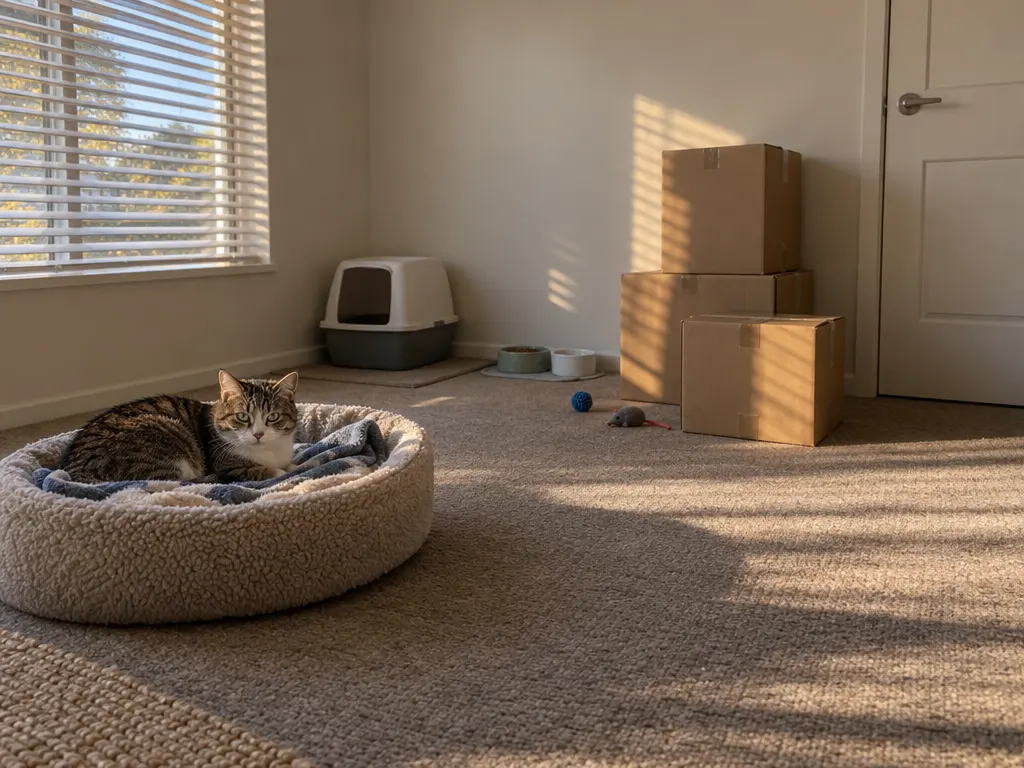
Keep the pet contained until the house goes quiet. RSPCA Australia says not to release pets into the new house until it is as quiet as possible, "for example after the removalists have gone".
Cats get a slow start. The advice is to confine a cat to one room for a couple of days with a bed, a familiar blanket and toys, a litter tray, food and water, then open up more rooms over the next few days. Unpack that room's box first, before the kitchen.
Dogs need a fence check. RSPCA Australia advises you to supervise dogs in the new home and check fences and gates, because a gate or fence you judge escape-proof is "not always" so. Walk the boundary yourself before the dog does. Look for gaps under side gates, loose palings and latches that don't catch.
Updating the NSW Pet Registry and your pet's tag
In NSW, cat and dog owners are required by law to keep their details and the pet's location up to date.
You can update the record in two ways:
- Online, using a MyServiceNSW-linked account, under the "Contact information and pet's location" section.
- On paper, if you can't go online, with the C3C change-of-details form lodged with your council "within 14 days of a change".
Remember the temporary rule too. If your pet lives at another location, even temporarily, you must update its location to stay compliant. A week with family while the house is packed is exactly the kind of stay to record.
Then do the two things a finder would actually use. RSPCA Australia says to update the new address on the microchip register and on the ID tag on the collar. A tag with the old address is worse than useless on a pet that has slipped out of an unfamiliar gate.
Renting or moving into strata with a pet
Renters. Tenants need the landlord's consent to keep a pet, except an assistance animal. The timing rules work like this:
- If you apply within 7 days after signing the agreement, you can keep the pet at the property while you wait for the written response. Miss that window and you need consent before the pet moves in.
- The landlord must respond within 21 days, and if they don't, the pet is automatically approved.
Our estimate of the timing: apply on day 7 and the 21 days can run to about four weeks after you signed. That is why applying inside the 7 days matters. It is what lets the pet move in with you rather than after.
The same page says four animals or fewer is a reasonable number. Tenants in a strata scheme may also need separate owners corporation approval if the by-laws require it, in addition to the landlord's consent.
Strata owners. An owners corporation cannot stop you owning a pet unless it causes "unreasonable interference". It also cannot charge a fee or bond, or require insurance, for a pet.
It may ask for the pet's name, type, breed, weight and age, a photo, vaccination records and a microchip number. Most schemes want written notice, so check the by-laws before you move in.
A strata "no pets" by-law is not valid, and banning pets by size, type or quantity "will not be valid in most circumstances", though the owners corporation still decides applications under its by-laws.
If you're heading into a building, our apartment moves page covers the move itself.
What to pack in the pet go-kit
Pack one bag that travels in the car with the pet, not in the truck:
- Water and bowls, including a spare, since RSPCA NSW suggests extra water bowls in case one is knocked over.
- A carrier or crate: a suitable carrier for cats and small dogs, or the crate if crate trained.
- The settling-in room kit: a bed, a familiar blanket and toys, a litter tray, food and water.
- Health records: vaccination, worming and external parasite control details, which a boarding facility or strata committee may ask for.
- The vet's number, saved in your phone, because the heatstroke advice ends with contact a vet immediately.
The pet moving plan at a glance
Five numbers carry most of this page. A dog in a parked car could die in as little as six minutes. Sydney's December and January mean maximums are only averages. A paper change of details for a cat or dog goes to your council within 14 days of a change. Renters have the 7-day and 21-day rules, and an assistance animal needs no consent at all.
Planning a summer move with a pet?
Sort out where the pet will be first, then book the move around it. When you're ready, send Vaucluse Removals your date and both addresses through our enquiry page. Mention any dogs, cats or caged pets in the house, so the day can be planned with them in mind from the start.
Sources
- RSPCA NSW, heat stress: https://www.rspcansw.org.au/information-and-advice/caring-for-animals/pet-hazards/heat-stress/
- RSPCA Australia, moving house with your pet: https://www.rspca.org.au/latest-news/blog/moving-house-your-pet/
- RSPCA Australia, finding a good boarding facility: https://kb.rspca.org.au/categories/companion-animals/pets-and-holidays/how-can-i-find-a-good-boarding-facility-for-my-companion-animal
- NSW Pet Registry, update your details: https://www.petregistry.olg.nsw.gov.au/pets/nsw-pet-registry/update-your-details-nsw-pet-registry
- NSW Government, driving distractions: https://www.nsw.gov.au/driving-boating-and-transport/driving-nsw/roads-safety-and-rules/warnings-and-hazards/driving-distractions
- NSW Government, pets in rentals: https://www.nsw.gov.au/housing-and-construction/rules/pets-rentals
- NSW Government, pets in strata: https://www.nsw.gov.au/housing-and-construction/strata/living/pets
- Bureau of Meteorology, Sydney (Observatory Hill) climate averages: https://www.bom.gov.au/climate/averages/tables/cw_066062.shtml
Pictures in this guide are illustrations, not photos of our jobs.