

Moving into a NSW strata apartment with a dog or cat comes down to one rule and one timing problem.
The rule: an owners corporation cannot stop you owning a pet as long as it does not disturb other residents, and it cannot charge a resident a fee or bond, or require insurance, for a pet.
The timing problem is the part people miss. If you rent, you may need two approvals, and only one of them runs on a fixed clock. The landlord has 21 days to respond. The owners corporation must decide in a "reasonable timeframe", with no number of days attached. Put the two side by side and the working is plain: the only deadline you can count on is three weeks, and the other has none. So both applications belong in the week you sign, not the week you move.
That is the view from Vaucluse Removals: settle the pet question in writing before you settle the moving date. What follows is general information, not legal advice. Fair Trading's own pages, linked throughout, are the place to check your situation.
What can an owners corporation ask for, and what can't it?
It may ask for or set
- The pet's name, type, breed, weight and age
- A photo
- Vaccination records and microchip number (if the pet needs these in NSW)
- Notice in writing to the secretary or strata manager, as the scheme's by-laws set out
- Rules on how pets are kept once you live there (within your property, supervised on common property, cleaned up after)
It cannot
- Charge a fee for a pet
- Take a bond for a pet
- Require insurance for a pet
- Make a by-law banning all pets (not valid)
- Ban animals by size, type or number (not valid in most circumstances)
Assistance animals: separate rules, cannot be banned.
Start with the notice. You may need to tell the owners corporation before you get a pet. Most schemes want it in writing to the secretary or strata manager, and your scheme's by-laws set the process.
What it may ask for is a short list: the pet's name, type, breed, weight and age; a photo; vaccination records and a microchip number. The last two apply only if the pet needs them in NSW.
What it may not ask for is money. No pet fee, no pet bond, no requirement to insure the animal: Fair Trading says it cannot charge a resident a fee or bond, or require insurance, for a pet.
Once you live there, it can set rules on how pets are kept, such as keeping the animal within your property, supervising it on common property and cleaning up after it. Those are the rules worth reading before moving day, because moving day is mostly common property.
Can an owners corporation stop me bringing my pet?
| Constant noise that unreasonably affects another resident |
| Repeatedly running at or chasing a resident or animal |
| Attacking or threatening |
| Repeated damage to property |
| Risking health through infection or infestation |
| A constant unpleasant smell |
| Breaching a nuisance order on a cat or dog |
| Examples of a pet that can be rejected include a restricted breed, or a dog declared dangerous or menacing. |
In most cases, no. A "no pets" by-law is not enforceable, because Fair Trading says by-laws banning all pets are not valid.
Rules that ban animals by size, type or number “will not be valid in most circumstances”. Fair Trading's by-laws page says the same thing from the other side: by-laws cannot stop a resident owning a pet unless it unreasonably interferes with others.
That phrase is the real test. A pet can only be rejected if it causes "unreasonable interference", and Fair Trading's examples include a restricted breed, or a dog declared dangerous or menacing.
The pets page lists what unreasonable interference means: constant noise that unreasonably affects another resident, repeatedly running at or chasing a resident or animal, attacking or threatening, repeated damage to property, risking health through infection or infestation, and a constant unpleasant smell. Breaching a nuisance order on a cat or dog also counts.
So the honest answer to "can you have pets in strata?" is usually yes, with two conditions. Your scheme can require you to tell it, and it can set rules on how the pet is kept.
Renting? You may need two approvals, on two different clocks
For a tenant, the strata side is only half of it. A tenant may need separate approval from the owners corporation if the by-laws require it. That approval is in addition to the landlord's consent, and it is a separate application. Fair Trading's advice is to submit both as soon as possible and bring the pet in only after both approvals.
The landlord's clock is the one with numbers. The landlord has 21 days to respond, and no response means automatic approval without conditions.
There is also a 7-day window. If you apply within 7 days after signing a new tenancy agreement, you can keep the pet there while you wait. Miss it and you need consent first. That window covers the landlord's side only. If your by-laws require owners corporation approval, that is still its own question.
Our working on the timing: if your lease starts less than three weeks after you apply, the landlord can lawfully take until after you have moved to answer. Apply on the day you sign.
Two more numbers from the rental rules. Four animals or fewer is a reasonable number under the rental laws. And in NSW, dogs and cats must be microchipped and registered, which is worth having sorted before either application goes in.
Who do I tell, and what do I send, before the removalists arrive?
Before you book the move date
Sources: NSW Fair Trading, Strata by-laws, NSW Fair Trading, Pets in strata, NSW Fair Trading, Keeping a pet in a rental property
First, get the by-laws. How depends on who you are:
- Buyers get the by-laws attached to the contract of sale.
- Tenants must be given the by-laws before signing the rental contract.
- Current residents can ask the strata secretary or manager, or buy a copy from an NSW LRS-approved information broker.
Second, write to the secretary or strata manager. Send what the owners corporation may ask for: name, type, breed, weight and age, a photo, and vaccination records and microchip number if your pet needs them. One email with everything attached saves a round of follow-up questions.
Third, renters send the landlord application at the same time. It is a separate application, on its own 21-day clock.
Fourth, keep the replies. Fair Trading says that if the owners corporation doesn't follow the rules, "your pet will be automatically approved". A written yes is still easier to show a building manager on moving day than a silence.
What should moving day look like in a strata building with a pet?
Moving day: check your by-laws for
Where the pet goes
Sources: NSW Fair Trading, Pets in strata, RSPCA Australia, Moving house with your pet
Check your own by-laws here rather than relying on a general rule, because buildings differ. The conduct rules Fair Trading describes cover keeping the animal within your property, supervising it on common property and cleaning up after it. On a move day, the lobby, lift and corridors are full of trolleys, open doors and people carrying furniture. That is exactly where those rules bite.
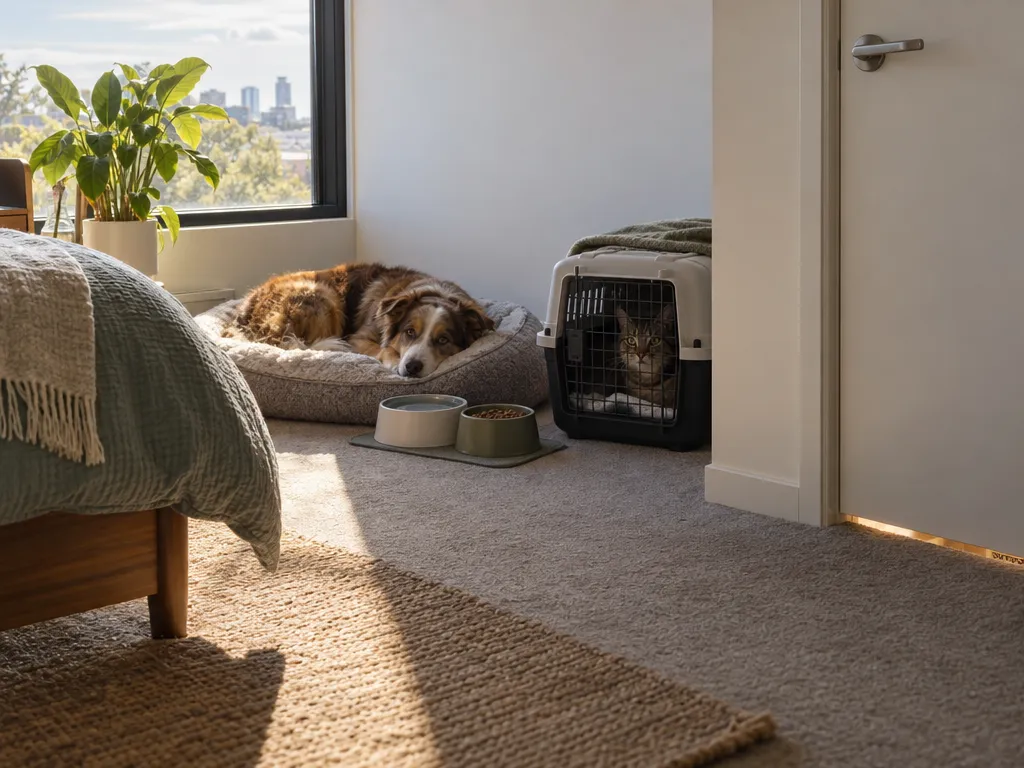
Then decide where the pet spends the day. RSPCA Australia suggests that if the pet is with you, keep it in one room with food and water, or in its crate if crate trained, and use a suitable carrier for cats and small dogs. Don't let it loose in the new apartment until it is quiet, "for example after the removalists have gone".
Tell your removalist which room is the pet's room, so that door stays shut all day. For heat, open gates and updating the microchip register, our earlier guide on moving house with pets in a Sydney summer covers it. For the apartment side of the move itself, see apartment removals in Vaucluse and Rose Bay.
What happens if the owners corporation says no?
- 1Write and ask them to reconsider
- 2Ask for free Fair Trading mediation
- 3Apply to the NSW Civil and Administrative TribunalTenants: the owner's consent is needed before applying to the Tribunal.
There is a set path, and it starts quietly. If your pet is rejected, Fair Trading's steps are to write and ask them to reconsider, then ask for free mediation, then apply to the NSW Civil and Administrative Tribunal.
A tenant needs the owner's consent before applying to the Tribunal.
Most of this is a conversation, not a fight. A calm letter that answers the owners corporation's concern, with the details it is allowed to ask for, is the first step for a reason. If it stalls, Fair Trading mediation is free.
Assistance animals follow a separate rule
Assistance animals cannot be banned. The owners corporation may ask for one of the listed types of evidence, such as a statutory declaration, an accreditation or a health practitioner's statement, but it cannot specify which type or ask for private medical records.
After you move in: what if there's a complaint about the pet?
An owners corporation cannot evict you but may try to remove the pet. It can do that only for unreasonable interference or a by-law breach, and it must follow the proper process first. The Tribunal can order the animal removed.
For a by-law breach, the steps are a warning, a notice to comply, free mediation, then the Tribunal. The Tribunal can fine a resident who keeps breaching a by-law, and the maximum fines rise for a continued breach or an ignored order.
Barking has its own route. If the scheme can't fix a barking or similar problem, a neighbour can ask the local council for a nuisance order against a dog or cat.
If you hear of a "new" pet rule after you move in, check it was made properly. A by-law change needs a special resolution, with no more than 25% of votes against, and is not valid until it is registered with NSW Land Registry Services.
Pets in NSW strata on one page
Owners corporation
- May ask for the pet's details, photo, vaccination records and microchip number (if needed in NSW)
- Cannot charge a fee or bond or require insurance
- Decides in a "reasonable timeframe"
- Can reject only for unreasonable interference
Renters
- Landlord 21 days to respond
- Apply within 7 days after signing a new tenancy to keep the pet while you wait
- Four or fewer animals is a reasonable number under the rental laws
- Owners corporation approval is separate if the by-laws require it
Breaches
- Warning, notice to comply, free mediation, Tribunal
- The Tribunal can fine, and maximum fines rise for a continued breach or an ignored order
Planning an apartment move with a pet?
Get the by-laws, send the pet details in writing, and if you rent, send the landlord application the same day. Then book the move. When you send an enquiry to Vaucluse Removals, mention the pet, the room it will be shut in, and anything your by-laws say about lifts and common property. That way the day can be planned around them.
Sources
- NSW Fair Trading, Pets in strata: https://www.nsw.gov.au/housing-and-construction/strata/living/pets
- NSW Fair Trading, Strata by-laws: https://www.nsw.gov.au/housing-and-construction/strata/living/by-laws
- NSW Fair Trading, Keeping a pet in a rental property: https://www.nsw.gov.au/housing-and-construction/rules/pets-rentals
- RSPCA Australia, Moving house with your pet: https://www.rspca.org.au/latest-news/blog/moving-house-your-pet/
Pictures in this guide are illustrations, not photos of our jobs.